How to Brew Pour Over Coffee: A Step-by-Step Guide
Master pour over coffee brewing from setup to finish. Correct ratio, bloom technique, pour pattern, and how to dial in your V60, Chemex, or Kalita.
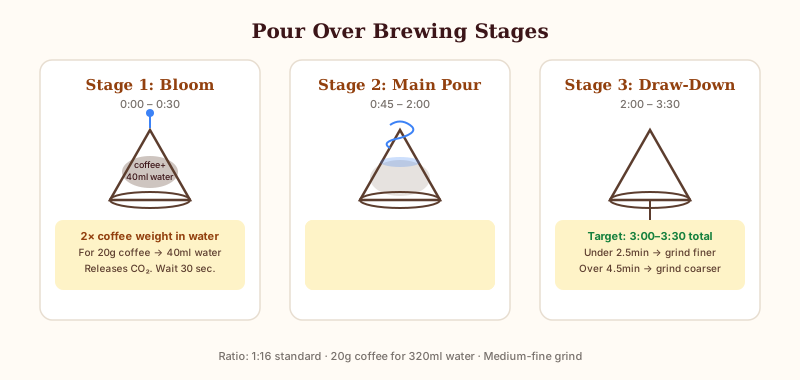
Pour over is probably the most talked-about manual brew method, and for good reason. When it works, it's extraordinary — clean, bright, and nuanced in ways that a drip machine rarely achieves. When it doesn't, it's frustrating and inconsistent.
The difference usually comes down to two things: ratio and pour technique. This guide covers both. To get your exact coffee amount before you start, use our [pour over ratio calculator](/coffee-ratio-calculator/pour-over).
Equipment You'll Need
- Pour over brewer (V60, Chemex, Kalita Wave, or similar)
- Paper filter (matched to your brewer)
- Kettle — gooseneck preferred for better pour control
- Kitchen scale accurate to 1g
- Timer
- Fresh-ground coffee (medium-fine grind)
- Water at 93–96°C (199–205°F)
You can brew without a gooseneck kettle, but pour control is harder. You can brew without a scale, but your results will vary. Both are worth having if you're serious about pour over.
The Ratio: Where to Start
The standard pour over ratio is **1:16** — one gram of coffee per 16ml of water. This is the baseline recommended by the Specialty Coffee Association for filter coffee and works well as a starting point for any pour over brewer.
For a standard 300ml cup, that means **18.75g of coffee** (round to 19g). For a larger 500ml brew, use **31g**.
Use our [coffee ratio calculator](/) to get precise amounts for your specific brew volume. The calculator also covers strength adjustments — use 1:14 if you want a stronger cup, 1:18 for lighter.
Brewing Steps: V60, Chemex, and Kalita
The core technique is the same across all three. The main differences are filter thickness (Chemex uses a thicker paper, slowing flow), shape (V60 tapers to a single hole, Kalita has three small holes at the bottom), and resulting cup character (V60 is brightest, Chemex is cleanest, Kalita is most forgiving).
Step 1: Rinse the Filter (Don't Skip This)
Place the filter in your brewer, set it on your cup or server, and pour hot water through to rinse. This removes paper taste and pre-heats your brewer.
Discard the rinse water. Then place your brewer on the scale, tare to zero, and add your coffee grounds.
Step 2: The Bloom — Most Important Step
The bloom is a 30-second pre-infusion that dramatically improves extraction quality. Pour **twice the weight of your coffee** in water — slowly, in a circular motion, saturating all the grounds.
For 20g of coffee, pour 40ml of water. Start your timer.
Fresh coffee releases CO₂ when hot water hits it. This gas, if not released first, creates uneven extraction during the main brew — water finds paths of least resistance around gas pockets, leaving some grounds under-extracted. The bloom lets the gas escape before you pour the rest of your water.
Watch the grounds "bloom" — they'll puff up and bubble. If you see very little activity, your coffee may be stale (try fresher beans).
Step 3: The Main Pour
At 30–45 seconds, begin your main pour. Pour in slow, steady circles starting from the center and spiraling outward, then back inward. Keep the water level roughly consistent throughout — you're not trying to add all the water at once.
For most pour over brewing, you'll do 2–3 pours total:
- **Second pour**: at ~45 seconds, bring water level up to about 60% of target
- **Third pour**: at ~1:15–1:30, bring to 100% of target
Keep your kettle close to the surface of the grounds — pouring from too high agitates the bed too much.
Step 4: Draw-Down
After your final pour, let the coffee draw down completely. The ideal total brew time is **3–4 minutes** from the start of your bloom.
- Under 3 minutes: grind finer, or slow your pour
- Over 4.5 minutes: grind coarser, or pour more aggressively
Total brew time is your primary feedback signal. If the coffee tastes right but draws down too fast or slow, adjust grind size for next time.
Step 5: Taste and Adjust
Stir the coffee gently in your cup to mix. Taste it immediately.
- Too weak or thin? Use more coffee next time (lower ratio, like 1:15 or 1:14)
- Too bitter or harsh? Grind coarser first — bitter usually means over-extraction, not too strong a ratio
- Too sour or sharp? Grind finer, or increase water temperature slightly
- Uneven flavor (some sips different)? Work on your pour — aim for even saturation of the entire coffee bed
Chemex-Specific Notes
Chemex uses a 20–30% thicker paper filter than V60, which slows the flow and removes more oils. This produces an exceptionally clean cup. It also means you need a slightly coarser grind than V60 to avoid too-slow draw-downs (aim for 3.5–4 minutes total).
Chemex brewers come in 3-cup, 6-cup, 8-cup, and 10-cup sizes. These "cups" are 5oz each — not standard mug sizes. A 6-cup Chemex makes about 720ml (roughly 2 large mugs).
Kalita Wave Notes
The Kalita Wave has three small holes at the bottom instead of V60's single large hole. This slows flow slightly and creates a more even extraction across the bed. It's often recommended for beginners because it's more forgiving of imperfect pour technique.
The flat-bottomed design means the entire coffee bed is at the same depth, which promotes even extraction. V60's sloped sides mean grounds at the edges may drain faster — this is why V60 rewards careful, even pouring more than Kalita does.
Common Pour Over Mistakes
**Not rinsing the filter**: Paper flavor is real and it ruins a good coffee. Always rinse.
**Pouring too fast**: Dumping the water in quickly instead of pouring slowly and evenly leads to uneven extraction and off flavors.
**Wrong grind size**: For pour over, you want medium-fine — similar to table salt. Too coarse and water races through (under-extraction, sour). Too fine and it chokes up (over-extraction, bitter). If you're getting one-hole clogging with V60, grind coarser.
**Stale coffee**: Pour over can't hide stale coffee the way milk drinks can. The bloom test tells you — very little bubbling means old beans.
**Inconsistent pour**: Try to maintain an even flow rate. Pausing and starting creates uneven extraction zones. Use a gooseneck kettle to help.
Getting Your Ratio Right First
Before worrying about technique, get your ratio right. Use our [pour over coffee calculator](/coffee-ratio-calculator/pour-over) — enter your target brew volume and it gives you the exact grams of coffee to weigh out. Technique matters, but an incorrect ratio makes good technique irrelevant.
Start with 1:16. Once you're getting consistent results at standard strength, you can experiment with 1:15 for more body or 1:17 for a lighter, more delicate cup. Different beans respond differently — a natural-process Ethiopian at 1:16 will taste very different from a washed Kenyan at the same ratio.
Pour over is worth the effort. Once you develop the feel for it, you'll understand why so many coffee people make it their daily ritual.