French Press Coffee Ratio: How to Get It Right Every Time
The correct French press coffee ratio is 1:14 at standard strength. Learn why, how to adjust it, and the technique mistakes that ruin a good ratio.
French press is one of the most forgiving brew methods — and one of the most commonly done wrong. The equipment is simple and the process looks easy, but a few consistent mistakes turn an excellent full-bodied coffee into something bitter and gritty.
The ratio is your starting point. Get that right, and you've solved half the problem before you even pick up the kettle.
The French Press Ratio
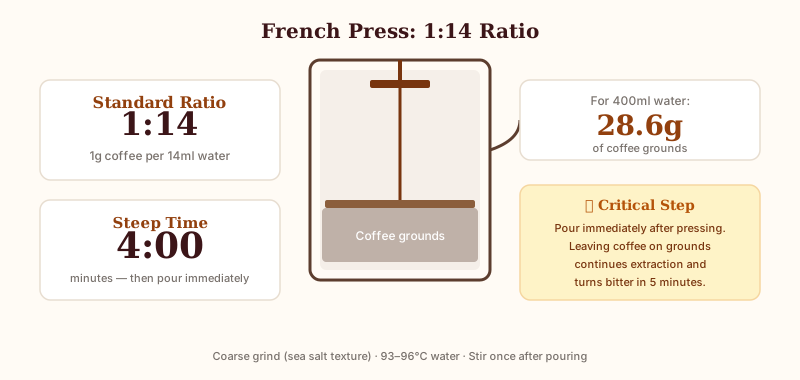
The standard French press ratio is **1:14** — one gram of coffee for every 14ml of water. This is slightly heavier than pour over or drip (both 1:16) because French press uses a coarser grind, which extracts less efficiently per gram of coffee.
For common press sizes:
- **350ml press (12oz)**: 25g of coffee
- **500ml press (17oz)**: 36g of coffee
- **750ml press (24oz)**: 54g of coffee
- **1-liter press (34oz)**: 71g of coffee
Use our [French press coffee calculator](/coffee-ratio-calculator/french-press) to calculate the exact amount for your press size. Enter your water volume and it gives you the grams of coffee in seconds.
If you prefer your coffee stronger, use 1:12 (about 29g per 350ml). For a lighter cup, try 1:16 (22g per 350ml).
Why French Press Uses a Different Ratio Than Drip
French press is a full-immersion method. Grounds stay in contact with water for the entire brew (3–4 minutes), extracting continuously. Compare that to drip or pour over, where water passes through the grounds relatively quickly (2–3 minutes of actual contact per water molecule).
The key reason for the heavier ratio isn't the longer steep time — it's the grind. French press requires a coarse grind (about the texture of coarse sea salt) to prevent sediment in your cup and to work with the metal mesh filter. Coarser particles have less surface area than fine grounds, which means slower extraction per gram of coffee. A heavier ratio compensates.
If you used a 1:16 ratio with coarse French press grind, you'd likely find the coffee tastes weak and slightly sour — under-extracted. Moving to 1:14 or 1:15 corrects for this.
The 4-Minute Steep: Why Timing Matters
After pouring your water (at 93–96°C), stir gently to make sure all grounds are saturated, then put the lid on with the plunger pulled up and set a timer for **4 minutes**.
Four minutes is the sweet spot for coarse grind full-immersion brewing. Under 3 minutes and the coffee is under-extracted (sour, thin). Over 5 minutes and you risk over-extraction (bitter, harsh).
After 4 minutes, press the plunger slowly and steadily. Don't force it — if there's a lot of resistance, your grind is too fine. If it falls with no resistance at all, the grind is too coarse.
The Most Important Step Most People Skip
**Pour immediately after pressing.** Do not leave the coffee sitting in the press after you've pressed the plunger.
This is the most common French press mistake. The grounds are still in contact with the hot coffee below the plunger filter. Even though they're no longer suspended in the water, extraction continues as long as they're touching hot liquid. Leave it for 5 minutes and your coffee turns bitter.
Press, pour into a thermal carafe or cup, done. If you want to keep a large batch hot, transfer to a pre-warmed thermal carafe.
Getting the Grind Right
For French press, use a **coarse grind** — the texture of coarse sea salt. If you're using a blade grinder, pulse briefly (about 5 seconds) rather than grinding continuously.
The grind size is your secondary adjustment dial after the ratio. If your coffee at 1:14 tastes too bitter, try a slightly coarser grind before reducing the coffee amount. If it tastes too weak and flat even at 1:14, try a slightly finer grind (or increase to 1:12).
The metallic mesh filter in French press allows coffee oils and fine particles through, which gives French press its characteristic full-bodied, slightly heavier mouthfeel compared to paper-filtered methods. If you see a lot of sediment in your cup, grind coarser.
Common Mistakes and Fixes
**Too bitter:**
- Grind is too fine (most common cause)
- Water is too hot (try 90–93°C instead of 96°C)
- Steeping too long (stick to 4 minutes)
- Leaving coffee sitting in the press after plunging
**Too weak or watery:**
- Grind too coarse
- Not enough coffee (check your ratio)
- Water temperature too low
**Too much sediment:**
- Grind is too fine
- Letting the press sit unstirred — some grounds float and don't extract, leading you to use too much next time
**Oily, heavy, or muddy mouthfeel:**
- This is normal for French press — it's the oils that pass through the metal filter
- If it's excessive, try rinsing your press filter under hot water before use to clear old oils from the mesh
Brewing French Press Step-by-Step
1. **Weigh your coffee**: Use the [calculator](/coffee-ratio-calculator/french-press) for your press volume
2. **Grind coarse**: Sea salt texture
3. **Heat water**: 93–96°C (remove from boil, wait 30–45 seconds if you don't have a temperature-controlled kettle)
4. **Add coffee to press**
5. **Start timer, pour water**: Pour all at once (unlike pour over, there's no bloom — you're going for full saturation immediately)
6. **Stir**: Briefly stir to ensure all grounds are saturated
7. **Lid on, wait 4 minutes**
8. **Press slowly**
9. **Pour everything immediately**
That's the whole process. The ratio and the "pour immediately" rule are the two things that make the biggest difference for most people.
Adjusting for Your Coffee
Light roasts tend to need a slightly heavier ratio in French press — try 1:13. They're denser beans that extract more slowly, and the coarser French press grind makes extraction even slower. A heavier dose gets you to the right strength.
Dark roasts extract more easily (the roasting process breaks down the bean's cell structure). At 1:14, a dark roast French press might taste harsh. Try 1:15 or 1:16 instead.
Freshly roasted coffee (within 1–2 weeks of roast date) produces a better bloom and more CO₂, which can make the coffee taste brighter. Older coffee (>4 weeks past roast) has lost most of its gas and aromatics — no ratio adjustment fixes stale coffee.
For exact gram calculations for any French press size and strength preference, our [French press ratio calculator](/coffee-ratio-calculator/french-press) handles the math instantly.