Coffee to Water Ratio: The Complete Guide
Learn the exact coffee-to-water ratio for every brew method. Why it matters, how to measure correctly, and how to adjust for your taste.
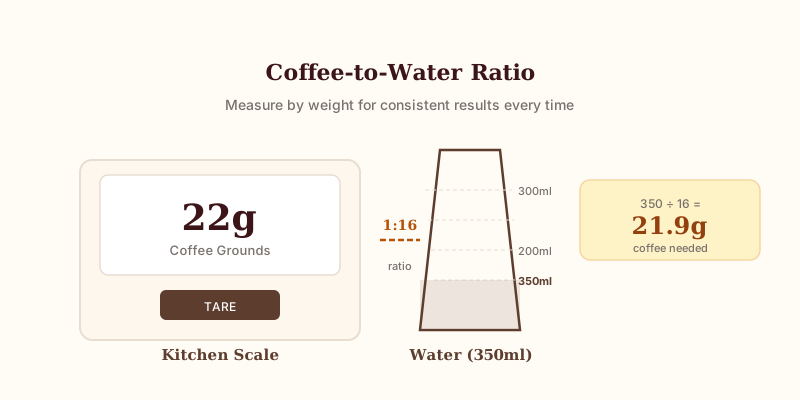
Getting your coffee-to-water ratio right is the difference between a great cup and a mediocre one. Every other variable — grind size, water temperature, brew time — works within the range your ratio sets. Get the ratio wrong and no amount of technique will save you.
This guide covers what the coffee-to-water ratio actually means, where the numbers come from, and how to apply them for every common brew method. If you want to skip straight to the numbers, use our [coffee ratio calculator](/) to get the exact amount for your water volume and brew method.
What "Coffee-to-Water Ratio" Actually Means
A brew ratio expresses how much coffee you use relative to how much water. A 1:16 ratio means one gram of coffee for every 16 grams (or ml) of water. That's it.
Water and grams are interchangeable here because water's density is approximately 1g/ml at brewing temperatures. So 300ml of water weighs about 300g. This means you can express ratios in either unit — they're the same.
The ratio tells you two things at once: how strong your coffee will taste, and how efficiently you're extracting flavor from the grounds. A lower ratio number (like 1:10) means more coffee per unit of water — stronger, more concentrated. A higher ratio number (like 1:18) means less coffee — lighter, more delicate.
The SCA Golden Cup Standard
The most widely referenced standard in the coffee world comes from the Specialty Coffee Association (SCA). Their Golden Cup Standard defines the optimal brew ratio for filter coffee as approximately **55 grams of coffee per liter of water** — or about 1:18.2.
This number wasn't pulled from thin air. The SCA developed the Brewing Control Chart by testing thousands of cups and plotting extraction yield (the percentage of the coffee's mass that dissolved into water) against soluble concentration (how much dissolved material is actually in your cup). Tasters scored cups across that range, and the optimal zone came out at 18–22% extraction yield with 1.15–1.45% TDS (Total Dissolved Solids).
In practical terms, the "Golden Cup" range spans roughly 1:14 to 1:20 for filter methods. The midpoint is around 1:16 to 1:17 — which is what most specialty coffee shops use as their baseline.
The key takeaway: the SCA standard is a range, not a fixed point. Where you land within it depends on your beans, your taste preferences, and your brew method.
Why Ratio Matters More Than Recipe
A lot of brewing guides give you a recipe: "use 2 tablespoons per 6 ounces of water." The problem is that recipes based on volume are unreliable.
A tablespoon of coarsely ground French press coffee weighs about 4–4.5 grams. A tablespoon of finely ground espresso weighs about 7–8 grams. That's nearly a 2:1 difference in actual coffee mass from the same "tablespoon." Your recipe gives wildly different results depending on how coarsely you grind.
The ratio, by contrast, works in grams. It doesn't care about grind size — it measures mass. Once you dial in a ratio that works for you, it stays consistent from morning to morning, grinder to grinder.
If you don't have a kitchen scale yet, [our calculator also shows tablespoon approximations](/), but treat those as rough estimates. A $10–$15 digital scale is the single best upgrade you can make to your coffee routine.
Standard Ratios by Brew Method
Different methods require different ratios because they work differently. Here's what to use at standard strength:
**Drip / Filter Coffee: 1:16**
The SCA Golden Cup applies most directly here. Most automatic drip machines hit the right temperature (93–96°C) and contact time automatically. A 1:16 ratio gives a balanced, clean cup.
**Pour Over (V60, Chemex, Kalita): 1:16**
Same baseline as drip, but you control every variable manually. The bloom step (pouring twice the coffee weight in water for 30 seconds) degasses the coffee before the main brew, improving extraction. Our [pour over ratio calculator](/coffee-ratio-calculator/pour-over) pre-fills this method.
**French Press: 1:14**
Full immersion for 4 minutes means prolonged extraction. The coarser grind used in French press has less surface area than drip grind, so it extracts more slowly — a slightly heavier ratio compensates. Use our [French press calculator](/coffee-ratio-calculator/french-press) for exact amounts.
**AeroPress: 1:13**
AeroPress is the most flexible method. It can mimic espresso at 1:4 or brew like a filter at 1:18. The "standard" here is a medium-strength filter-style brew. Adjust aggressively based on your preferences.
**Espresso: 1:2 (yield ratio)**
Espresso works differently. The ratio measures grounds IN to liquid espresso OUT — not total water. 18g of grounds should produce 36g of espresso (a 1:2 yield). This is called the dose-to-yield ratio. Total water passing through the puck is much higher, but the grounds absorb most of it. Our [espresso ratio calculator](/coffee-ratio-calculator/espresso) handles the dose-to-yield math.
**Cold Brew Concentrate: 1:5**
Cold water extracts flavor compounds far less efficiently than hot water. You need much more coffee and much more time (12–24 hours). The resulting concentrate is diluted 1:1 before drinking, giving an effective final ratio of about 1:10. See our [cold brew calculator](/coffee-ratio-calculator/cold-brew).
**Moka Pot: 1:8**
The Moka pot is often described as "stovetop espresso" but it's not — the pressure is much lower than an espresso machine. It brews a concentrated, intense coffee that's somewhere between espresso and drip.
**Turkish Coffee: 1:12**
Fine-to-powder grind, brought to a near-boil with the coffee and water together. No filter — grounds settle to the bottom of the cup. The ratio is strong because of the fine grind and short contact time.
How to Adjust for Taste
If your coffee tastes weak or watery, reduce the ratio number (use more coffee relative to water). If it tastes too bitter or harsh, increase the ratio number.
Move in small steps. Going from 1:16 to 1:14 is a large jump — try 1:15 first.
Before blaming the ratio, check your grind. Bitterness usually comes from too-fine a grind (over-extraction), not from a too-strong ratio. Sourness usually comes from too-coarse a grind (under-extraction), not from a weak ratio. If you're within the normal ratio range and the coffee still tastes off, adjust the grind before anything else.
Roast level also matters. Light roasts are denser and need a stronger ratio and higher temperature to extract properly. Dark roasts are more soluble and can taste harsh if brewed too strong — ease up to 1:17 or 1:18.
Measuring Correctly
You need:
1. A kitchen scale (accurate to 1 gram, $10–$15)
2. Your water amount in grams or ml
3. This ratio
Then: **coffee (g) = water (ml) ÷ ratio**
For 500ml of water at 1:16: 500 ÷ 16 = **31.25g of coffee**. Round to 31g.
That's it. No guesswork, no tablespoon inconsistency. Use our [coffee ratio calculator](/) to do the math instantly for any brew method and water volume.
Summary
The coffee-to-water ratio is the foundation of good coffee. Get it in the right range for your method, measure by weight rather than volume, and you've solved 80% of the consistency problem. Everything else is fine-tuning.
Start with the standard ratio for your method, taste the result, then adjust from there. You'll nail your recipe faster than you expect.